TENS、EMS、And light therapy is、Non-invasive technology that supports health, recovery, and wellness with different approaches.。pain relief、muscle training、Conditioning at the cellular level、Each technology has its own characteristics。By understanding these differences、Users and businesses in the medical, beauty, and wellness industries、Makes it easier to choose the solution that fits your purpose。
What is TENS?
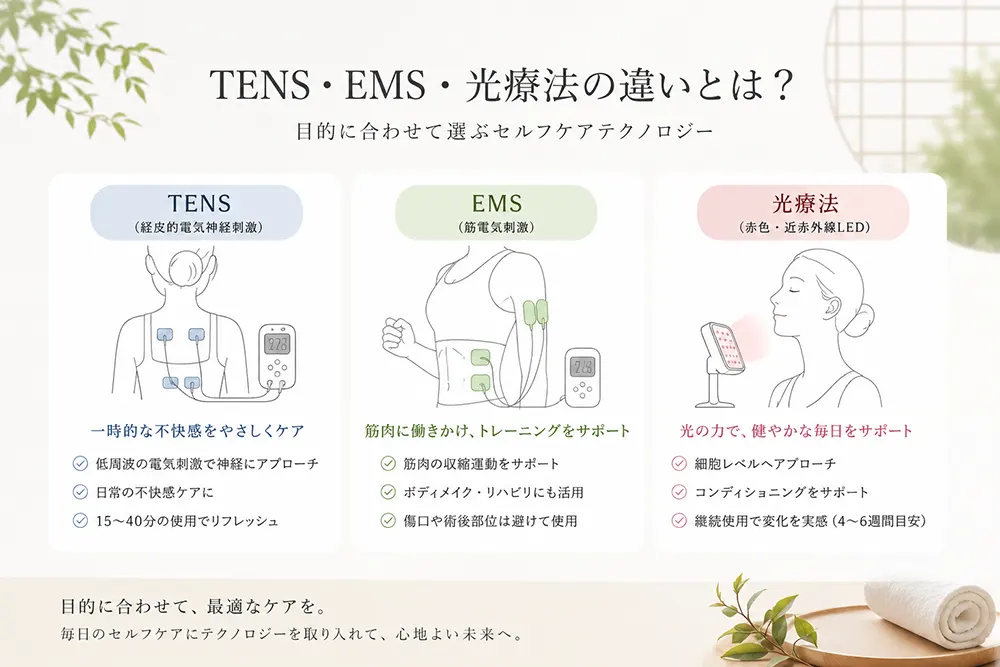
TENS (transcutaneous electrical nerve stimulation therapy)、By applying low frequency electrical stimulation to the skin、Non-invasive care that supports temporary pain relief。Sends weak electrical signals from electrode pads attached to the body、By suppressing pain transmission、reduces discomfort。
It is mainly used in the following situations:
- discomfort around joints
- Nerve-related discomfort
- discomfort during menstruation
- Post-workout recovery
- Physical fatigue due to daily life
Typical usage time is about 15 to 40 minutes.、Accompanied by mild irritation or tingling sensation。While TENS tends to provide immediate comfort,、It is not intended to fundamentally improve your condition.。
What is EMS?
EMS (Electrical Muscle Stimulation)、Uses stronger electrical stimulation than TENS、Technology that contracts and relaxes muscles。Works to reproduce muscle movements during exercise、Supports muscle conditioning。
EMS is mainly:
- muscle training
- body makeup
- Rehabilitation assistance
- muscle strength maintenance
- exercise support
It is used for purposes such as。
Whereas TENS focuses on the approach to nerves.、The big difference between EMS is that it works on the muscles themselves.。In addition、Use on wounds and post-surgical areas should be avoided。
What is light therapy?
Light therapy (photobiomodulation)、Utilizes red LED and near-infrared LED、Advanced wellness technology that approaches the cellular level。
Rather than electric stimulation like TENS or EMS、By irradiating the body with light energy of a specific wavelength、Acts on mitochondria within cells、Supports maintenance of original condition。
Main features:
- ATP (cellular energy) production support
- Blood circulation environment support
- Maintain condition
- Body care/skin care support
- Daily recovery care
A characteristic of light therapy is that it is easy to notice changes gradually with continued use.、Continuous use for 4 to 6 weeks is generally recommended.。
Also、Due to its convenience as non-invasive, cordless, and home care compatible、Attracting worldwide attention in the beauty, wellness, and self-care markets。
Combination of TENS and light therapy
By combining TENS and red light therapy、Synergistic self-care through different approaches is expected.。
- TENS:Supports immediate comfort
- Red light/near infrared light:Supports condition maintenance and daily care
each works by a different mechanism、There is also growing interest in combination devices in the wellness market.。
Which one should you choose?
TENS
Suitable for temporary discomfort care and relaxation purposes。
EMS
For muscle training and body conditioning。
light therapy
Next-generation care solutions that can cover a wide range of beauty, wellness, recovery, and daily self-care。
business perspective:Growing light therapy market
in recent years、With the expansion of the self-care and wellness market that does not depend on drugs、Demand for light therapy devices is growing rapidly worldwide。
especially:
- home beauty salon
- beauty machine
- sports recovery
- Equipment for salons
- wellness appliances
Recruitment is progressing in many fields such as。
OEM / Even in the ODM market、Red light therapy masks and panel devices are attracting attention as a category with high growth potential.。
Main differences between TENS, EMS, and light therapy
TENS、EMS、and light therapy、This technology is often included in home wellness devices.、Each works in a different way。
| technology | Main target | Main experience | general positioning |
|---|---|---|---|
| TENS | nerve | A tingling sensation | Temporary comfort support and condition care |
| EMS | muscle | Muscle contraction feeling | Muscle stimulation/body conditioning support |
| light therapy | Skin and tissues that react to light | Sensation of warmth/sensation of light irradiation | Beauty/wellness/scalp care/recovery support |
The simplest way to express it is:
- TENS approaches the nerves
- EMS approaches muscles
- Phototherapy is a technology that delivers light energy
There is a difference that。
This difference is、product development、User education、And it is very important for compliance in each country.。
Which technology is better?
There is no single "best technology"。
What's important is、Is it suitable for the product concept and brand strategy?。
Cases in which TENS is suitable
Suitable for products intended for:
- comfortable support
- temporary condition care
- relaxation support
Cases where EMS is suitable
Suitable for brands that value::
- muscle stimulation
- facial care
- body toning
- fitness recovery
Cases in which light therapy is suitable
This technology is compatible with the following markets::
- red light wellness
- skin care
- scalp care
- beauty routine
- recovery support
- Non-invasive light technology
What really matters to B2B buyers、
“Which technology is most suitable for our target customers, sales channels, price ranges, and compliance strategies?”
That's the point of view。
for example:
- Beauty brand → EMS facial device/LED mask
- Recovery brand → Red light panel/EMS/TENS device
- Hair Wellness Brand → Red Light Hair Growth Cap
- Pet Wellness Brand → Red Light Therapy Pad
etc.、The optimal direction differs for each brand.。
Can TENS/EMS/light therapy be combined?
yes。
Nowadays, the number of wellness devices that combine multiple technologies is increasing.。
example:
- EMS + Red light → beauty device
- TENS + Heat → Comfort device
- EMS + Vibration → Body care equipment
- red light + Near infrared → recovery panel
- EMS + light therapy + Massage → Multifunctional wellness equipment
While complex devices can increase added value,、Design, safety, and legal compliance become more important.。
For each additional feature:
- safety test
- label display
- Precautions for use
- Certification conditions
- Expression restrictions
etc. may increase。
References
University of Iowa Health Care. (2018). Contraindications and precautions: TENS therapy. UIHC.
https://uihc.org/sites/default/files/contraindication_precautions_best062018.pdf